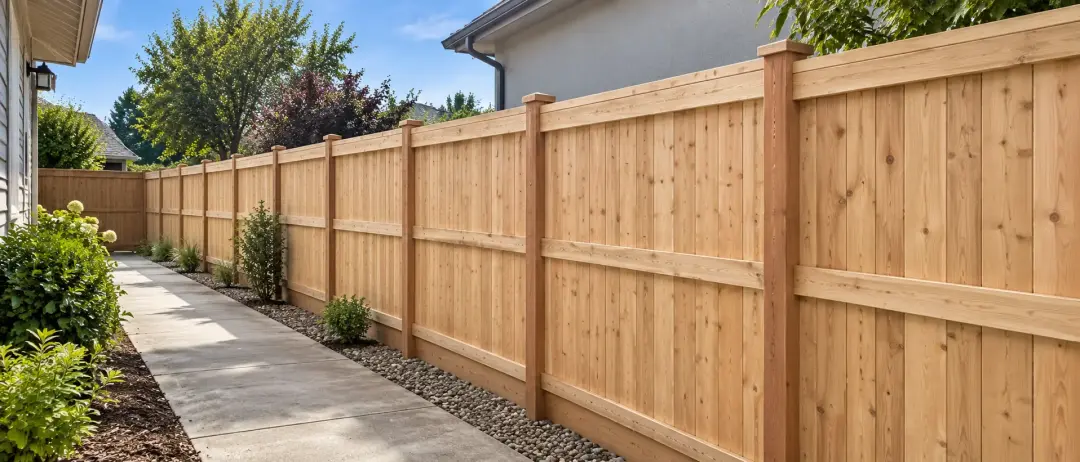
You can usually keep an established hedge and fit a wooden fence alongside it. The best position depends on the hedge’s mature width, the roots along the boundary and how you’ll reach both sides for trimming. Check these before ordering panels or deciding where posts will go.
Leave room to clip the hedge
Look at the hedge from ground level as well as from above. A clipped face can hide thick stems that lean towards the garden. Mark a possible fence line using string, then walk its length with your usual hedge-trimming tools. Check where you can stand, reach the lower growth and collect clippings.
There is no single spacing that works for every hedge. A regularly clipped privet hedge and a broad, mature beech hedge need different amounts of working space. Where the available gap is tight, discuss whether short, board-built sections or removable panels would give you better access than one continuous fixed run.
Plan the posts around established roots
Locate the thick stems and any visible surface roots before setting out the posts. Roots may extend under a bed or path long after the hedge has been clipped back. Ask your installer to mark the proposed post positions and explain how they would adjust the layout if a large root is in the way.
Shifting a post might mean cutting a panel to width or building a short section from individual boards. If major roots or mature trees are involved, get advice from an arborist before excavation. Also show the installer where you know of buried cables, irrigation pipes or drain runs.
Account for moisture and uneven soil
Clear loose leaf build-up from the proposed fence line and look for places where the soil sits higher behind the hedge. Damp debris packed against timber can hold moisture at the base. A gravel board can keep the timber above the soil, and stepped bays may suit a boundary that changes level.
If the hedge stands on a bank, show the installer both sides. A fence and its gravel board ordinarily define a boundary. Soil that needs holding back calls for a separate retaining detail, which should be discussed before the installer sizes the fence.
Are you considering garden fencing installation or replacement?
MD Fencing & Decking work throughout Hertfordshire and Buckinghamshire, covering the A10 corridor from the start of the M25 up into Buntingford. Our services also cover Milton Keynes and nearby areas including:
Keep a route through the boundary for wildlife
The People’s Trust for Endangered Species reports that its Living with Mammals survey has recorded 14,000 annual surveys across 7,000 sites since 2003. Hedgehogs appear at fewer survey sites than at the start, although weekly counts have recovered in recent years at sites where they are still recorded. Read the survey results.
If the hedge already provides a route between gardens, plan for the fence to preserve that route where it is safe to do so. Hedgehog Street recommends a 13 by 13 cm opening. Talk to your neighbour and ask about a purpose-made opening if you’re using a gravel board. Consider pets, nearby roads and where the opening leads. See Hedgehog Street’s guidance.
Agree access before work starts
Check whose hedge and fence they are, especially if the existing fence has disappeared into the hedge. Ask before arranging work that needs access from next door. If the hedge needs cutting back, check it for active nests and consult current guidance before trimming. Read the RHS hedge-trimming guide.
For an initial estimate, share a photo from each end, the approximate length of the run, a photo of any large roots and the width of the narrowest access point. Explain whether your priority is keeping the existing hedge, improving privacy or creating a secure space for pets. That helps the installer assess the layout before materials are ordered.
Summary
Keep enough room to care for the hedge, leave flexibility in post positions and decide how the fence will meet the ground. If you’re planning a timber boundary beside an existing hedge, share photos of the proposed fence line when you enquire.