Choose a garden gate by deciding how it needs to work before choosing its appearance. Privacy, everyday access, the available opening and the strength of the supporting posts all matter. This guide explains how to compare designs, materials and fittings, then turn those choices into a practical brief for a gate that suits your home.
Choosing Garden Gates in Milton Keynes
Start with the entrance itself. A front garden gate often marks the boundary and welcomes visitors; a side gate may need to screen a passage and secure the rear garden. A gate within the garden might simply separate a patio from planting. Those are different jobs, so the same design will not suit every position.
The English Housing Survey, updated in July 2026, reports that 82% of dwellings in England had a private plot in 2024, rising to 92% among owner-occupied homes. A private plot can include paving or other outside space, rather than a garden alone. These official outside-space figures underline why access should be considered as part of the whole property: the route beyond the gate matters as much as the entrance.
Decide How Much Privacy You Want
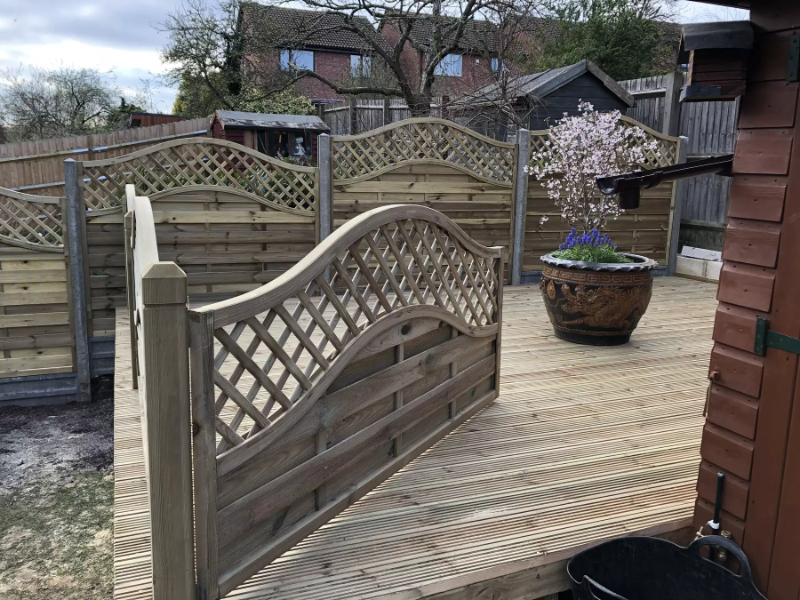
Close-boarded timber gives a more screened appearance than pickets or widely spaced slats. That can suit a side passage beside a patio or kitchen window. An open upper section can let you see approaching visitors and soften the look of a boundary, but it will also allow views through.
Walk along the approach from both directions before deciding. Think about what someone can see at standing height and where the latch will be reached. A decorative curve changes the silhouette, while the lowest point still determines how much screening the gate provides. In an exposed opening, ask the installer to assess the loading on a solid design rather than assuming a heavier gate is automatically a better one.
Compare Materials and Future Upkeep
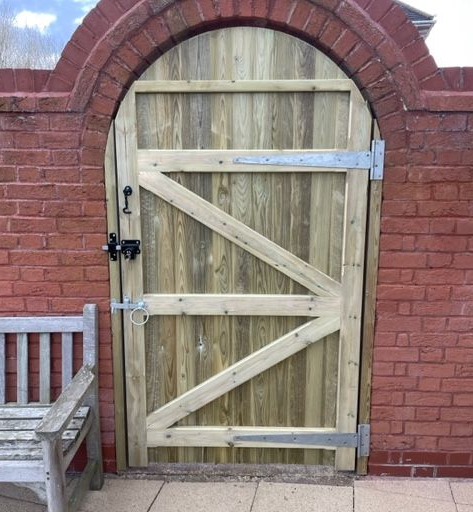
Timber offers a natural finish and can be made to complement existing fencing. Ask which timber is proposed, whether it is preservative treated, and what care the maker recommends. Softwood and hardwood describe broad groups: construction, treatment, exposure and detailing are more useful than a label alone when comparing quotations.
Metal, composite and aluminium gates provide alternative appearances, but their repair methods, finishes and hardware differ. Compare the complete specification rather than assuming one material needs no attention. With any design, hinges and locks still need checking. For a wooden gate, request clear instructions for cleaning, compatible finishes and protecting exposed cut ends.
The Met Office reported provisionally in January 2026 that the UK recorded 1,648.5 sunshine hours in 2025, its sunniest year in the series beginning in 1910. That 2025 sunshine total is national context, not a forecast for your garden. An entrance exposed to strong sun and driving rain deserves a finish and care plan suited to its position.
Test the Design Against Everyday Use
- Check the widest item that regularly passes through, including bins, bikes and gardening equipment.
- Consider whether someone needs to open the latch while carrying shopping or managing a pushchair.
- Check that the gate can stay safely open without blocking the route.
- Look for steps, raised beds and walls that limit the usable swing.
Choose Hardware as Part of the Gate
A latch that looks attractive in a photograph may be awkward when approached from the other side. Decide whether you need access from both directions, a key-operated lock, a simple catch or additional bolts. Tell the installer about children, pets and any accessibility requirements so the position and operation can be discussed together.
For rear access, the RHS recommends keeping gates closed and locked where possible and fixing hinges securely to resist lifting. Its garden-security advice also suggests locks at both the top and bottom. Choose a solution appropriate to your access needs: additional locks should not leave a household member unable to operate the gate or use a necessary exit.
Are you considering garden gate installation or replacement?
MD Fencing & Decking work throughout Hertfordshire and Buckinghamshire, covering the A10 corridor from the start of the M25 up into Buntingford. Our services also cover Milton Keynes and nearby areas including:
Match the Gate to the Boundary
Use the fence as a visual reference without treating it as a structural specification. A gate made from boards similar to the fence may look consistent, but its frame and supporting posts must carry repeated movement. The hinges transfer the gate weight into the hinge-side support; a decorative panel alone does not provide that support.
For homes in Milton Keynes, MD Fencing & Decking offers custom wooden gates, design consultations and installation. Bring a photograph showing the full opening, another showing the surrounding boundary, and an explanation of how you use the entrance. That helps a discussion about style remain connected to the practical constraints of the site.
Compare Complete Quotes
Ask each installer to identify the gate construction, dimensions, posts, hinges, latch, finish and removal work included. Confirm whether making good disturbed paving or fencing forms part of the price. A lower figure may cover a gate leaf only, while another quotation includes new supports and installation.
Avoid choosing solely from an estimated lifespan or a promise of maintenance-free use. Request the actual care conditions and any written warranty. If you are considering changes to the rest of the boundary, our garden fencing service explains the related work available. A coordinated plan can prevent the gate being designed around posts that will soon be replaced.
Use a Shortlist Before Approving the Design
Reduce the choice to two or three designs and compare them against the same brief. For each one, note the view through the boards, the proposed latch, the opening direction and the finish. Ask to see the back of the gate as well as the front: the frame will be visible from the garden and may affect where a handle can sit.
Finally, decide which compromises you can accept. A decorative top may matter less than an easy latch; matching old fencing exactly may matter less than gaining useful passage width. Agree those priorities before approving a bespoke drawing, when changes are easier to make.
Summary: Choose a Gate That Fits Your Routine
The right garden gate balances privacy, manageable access, suitable supports and a finish you are willing to maintain. Take those priorities to MD Fencing & Decking to discuss a wooden gate designed around your property in Milton Keynes.